C. LICENSOR
-
No licensor. It is a duplicate
of the Champlin and IVEC
Cokers.
(IVEL currently 14,000 BPD
w/10,000 BPD design capacity)
-
Designed By Fluor
-
Built In 1982
D. PROCESS DESCRIPTION
Vacuum bottoms are heated
by heat exchange with heavy
coker gas oil, and in the
convection coils of the two
parallel coke heaters and
enters the coker fractionator
below tray 1 and on tray #3.
The bottom section of the
coker fractionator serves
as a direct contact heat exchanger
between the fresh feed and
the hot vapors from the coke
drum.
In the fractionator, part
of the vacuum bottoms feed
lighter than the heavy coker
gas oil product is vaporized.
The flashed feed is combined
with the condensed coke drum
vapor (recycle feed) in the
bottom section of the fractionator.
The combined flashed feed
and recycle are heated in
the two coker heaters
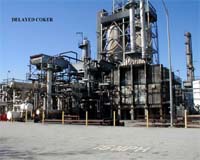
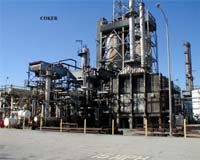
The Delayed Coker Unit has
two identical coke drums,
one which will be on stream
while the other is being in
some stage of cooling, decoking
or heating. The charge from
the coker heaters flow through
the transfer line and is directed
by the switch valve to the
bottom of the coke drum being
filled. The coke that is formed
accumulates in the drum while
the vapors pass overhead from
the top of the drum and flow
to the bottom section of the
coker fractionator. The coke
drums are on a 1 8-24 hour
cycle. The filled drum is
first steamed and then cooled
with water, and coke is cut
with a high pressure water
cutting tool and transported
in a slurry form to the Coke
Handling Unit.
The heavy coker gas oil is
withdrawn from the fractionator
and is used to preheat the
incoming vacuum bottom feed
and to generate 60 or 1 60
psig steam. Then it splits
into circulating reflux, quench
reflux, and product. The two
refluxes serve to adjust the
end point of the light and
heavy coker gas oils respectively,
and to remove heat from the
column. The product is then
sent to the FCC Feed Hydrotreater.
The light coker gas oil is
withdrawn as a sidestream
and sent to the stripper.
The stripped light coker gas
oil splits into a lean oil
stream and a product stream.
The hot lean oil is cooled
in the lean/rich light coker
gas oil exchanger and trim
cooler and sent to the pentane
absorber to absorb the butane
and pentane fraction of the
sour gas. The rich gas oil
from the pentane absorber
after being heated in the
lean/rich LSGO exchanger returns
to the fractionator. The light
coker gas oil product stream
is sent to the Lomax and Hydrocracker.
The fractionator overhead
stream which consists of naphtha
and sour gas, after being
air cooled and water cooled,
is sent to the fractionator
overhead accumulator. The
uncondensed vapor is compressed
and cooled, then mixed with
the coker naphtha from the
overhead accumulator and flashed
in the recontacting drum.
The vapor then flows to the
pentane absorber and Amine
Unit before being sent to
the refinery fuel gas system.
Naphtha from the overhead
accumulator is returned to
fractionator as overhead reflux
and sent to the Naphtha Unifiner
as product.
E. LIMITATIONS
1. Coker Feed Heaters, 12,000
BPSD.
2. Coker Gas Compressor Capacity
3. Fractionator Overhead Condensers
Expansion in 1992
4. The Coke drums, based on
24-hour cycle, 660 TPSD
5. A third heater will be
added in 1995.
F. MAINTENANCE TURNAROUND
Major T/A: 1987, 1989, 1993
Significant Project Activity.
Upgraded DCS 1990
Performed off gas compressor
reliability upgrdes 1992
Upgraded fractionator O/H
cooling capacity: 1993
Performed complete coke drum
inspection: 1993
Upgraded coke drum level indicators
1993
Installed new instrumentation,
field interface controller
1993
Partial replacement of coke
cutting water tank 1993
Partial replacement of LCGO
stripper 1993
New quench tower overhead
cooler (to be installed)
New replacement heater coil
(to be installed)
|